


If you’ve ever stood up from your desk, couch, or car seat and felt that familiar tightness across your upper back and shoulders, you’re not alone. Millions experience this, though no one chooses it on purpose. Upper back pain and stiffness are very common, especially among older adults and those who spend a lot of time sitting. The encouraging news is that simple stretching exercises for upper back pain relief are genuinely effective, easy to do, and require only a little floor space and a few minutes each day.
No gym, no equipment, and no tricky poses that need circus-level flexibility. Just easy, beginner-friendly moves, your upper back will thank you for.
Why Does the Upper Back Get So Stiff?
Your upper back, or thoracic spine, has 12 vertebrae and many muscles that help support your posture and keep you upright. When these muscles stay in one position for hours, they tighten up and start to protest.
Common reasons your upper back might be staging a protest include:
- Prolonged sitting or poor posture
- Stress and tension that settle in the shoulders and neck
- Weak core muscles that force the upper back to overcompensate
- Age-related changes in spinal flexibility
- Sleeping positions that leave the back twisted or unsupported
Here’s the thing about tight upper back muscles: the tighter they get, the worse your posture becomes. And the worse your posture gets, the tighter those muscles become. It’s a frustrating cycle, but regular stretching is one of the best ways to break it.
What Stretching Actually Does for Your Upper Back
Imagine your upper back muscles like a rubber band left in a drawer for years. It still works, but has lost much of its stretch and snap. Gentle, regular upper back stretching exercises help bring back that flexibility over time.
Regular stretching for the upper back helps to:
- Release muscle tension and reduce tightness.
- Improve posture and spinal alignment.
- Increase blood flow and oxygen to the muscles.
- Reduce the frequency and intensity of pain flare-ups.
- Improve your overall range of motion and daily comfort.
You don’t need to stretch for hours to notice a difference. Just 10 to 15 minutes regularly can bring real improvements.
Before You Start: A Few Friendly Reminders
Consider these quick safety tips before you get started.
- Gentle pulling is fine. Sharp pain is not. If something hurts beyond a mild stretch sensation, back off immediately.
- Remember to breathe during every stretch. Holding your breath tightens the muscles you want to relax, which isn’t helpful.
- Move slowly and with control. Jerky or rushed movements can cause more harm than good.
- Consistency is more important than intensity. Five minutes every day works better than one intense hour once a week.
- Talk to your doctor first if you have had a recent injury, surgery, or a diagnosed spinal condition.
Ready to give your upper back some well-deserved care? Let’s get started.
Easy Upper Back Stretches for Pain Relief: Your At-Home Routine
If you are new to stretching or currently in a flare-up, begin with these gentle movements. They are low-effort, high-reward, and perfectly suited for anyone just getting started.
1. Chin-to-Chest Stretch
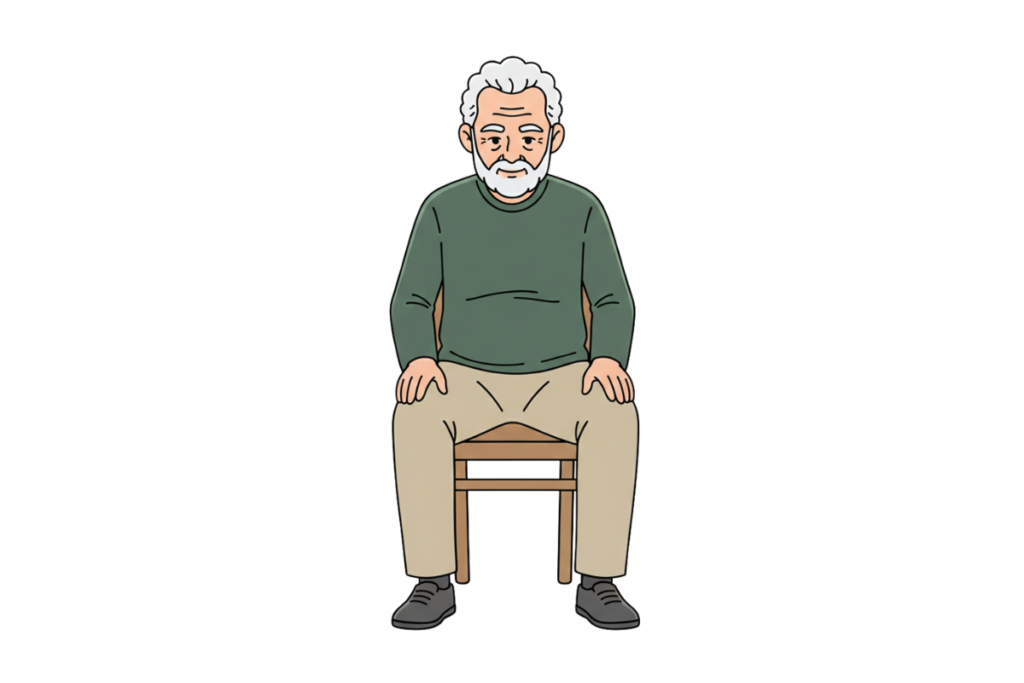
This might be the simplest stretch on the entire list, but do not let that fool you. It directly targets tension in the upper back and neck area that builds up from hours of looking at screens.
How to do it:
- Sit up straight in a chair or stand with your feet hip-width apart.
- Slowly drop your chin down toward your chest.
- Let the weight of your head create a gentle stretch along the back of your neck and upper back.
- Hold for 20 to 30 seconds and breathe deeply.
- Slowly lift your head back to neutral.
- Repeat 3 times.
No pulling or forcing required. Gravity does the work for you here.
2. Shoulder Roll
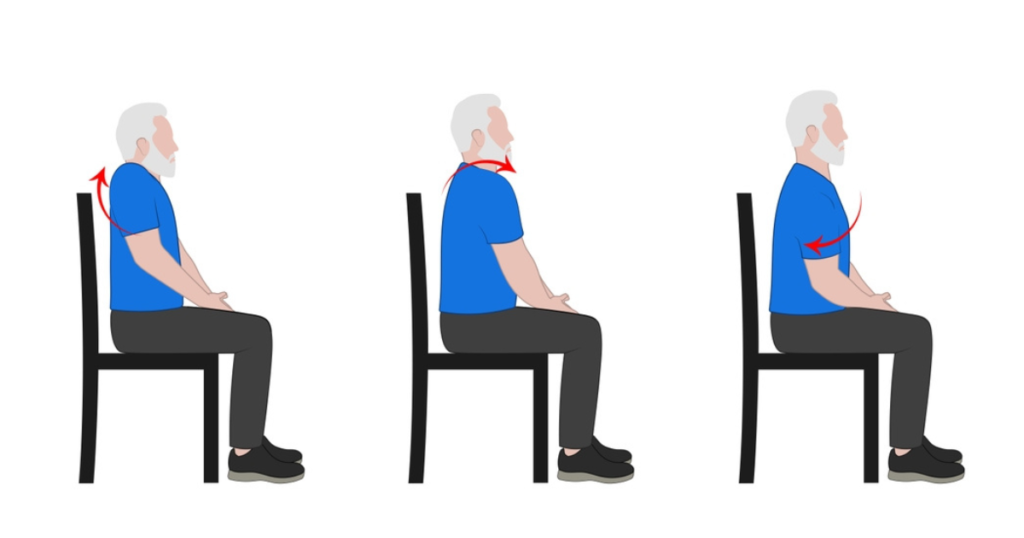
This one is so simple, you can do it right now while reading. Go ahead—no one’s watching.
How to do it:
- Sit or stand comfortably with your arms relaxed at your sides.
- Slowly roll both shoulders forward in large, smooth circles 5 times.
- Then reverse direction and roll them backward 5 times.
- Breathe slowly and let your shoulders drop away from your ears with each roll.
- Repeat the full sequence 2 to 3 times.
This simple movement releases tension in the upper trapezius and the muscles along the top of the shoulders. It is a great warm-up before moving into deeper stretches.
3. Seated Thoracic Extension
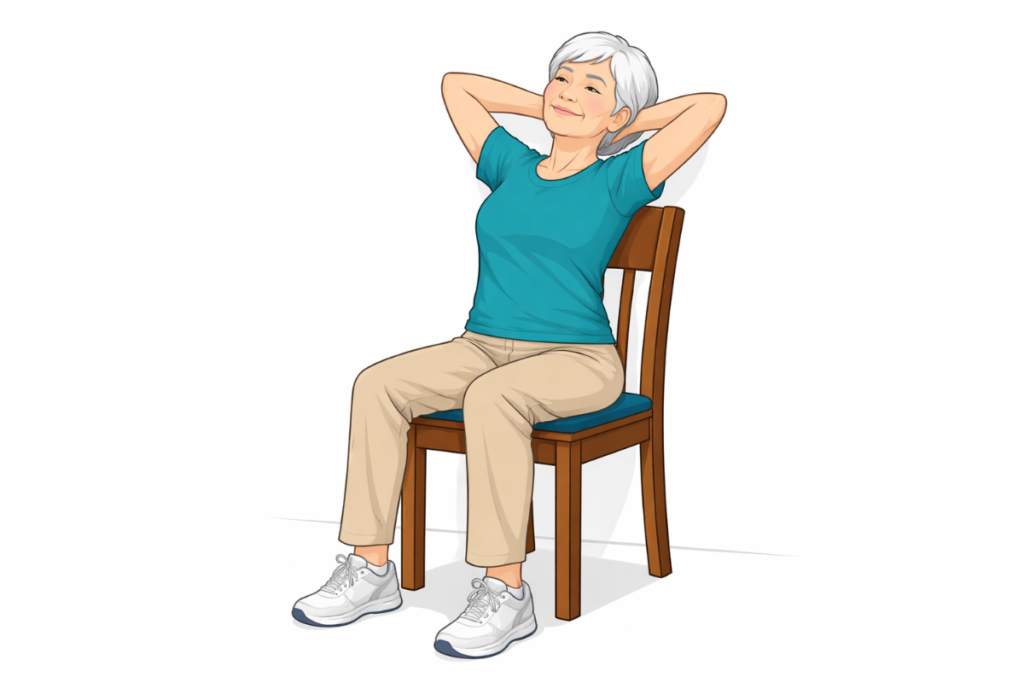
This stretch gently opens the thoracic spine, the part of your back that tends to round forward and get stiff from sitting.
How to do it:
- Sit in a sturdy chair with your feet flat on the floor.
- Interlace your fingers and place your hands behind your head.
- Slowly lean back over the top edge of the chair, letting your upper back gently arch over it.
- Hold for 10 to 15 seconds and breathe into the stretch.
- Slowly return to sitting upright.
- Repeat 3 to 5 times.
For best results, use a chair with a firm backrest. A very soft chair won’t give the same effect and might just make you want to nap, which is understandable, but not the goal right now.
4. Cat-Cow Stretch
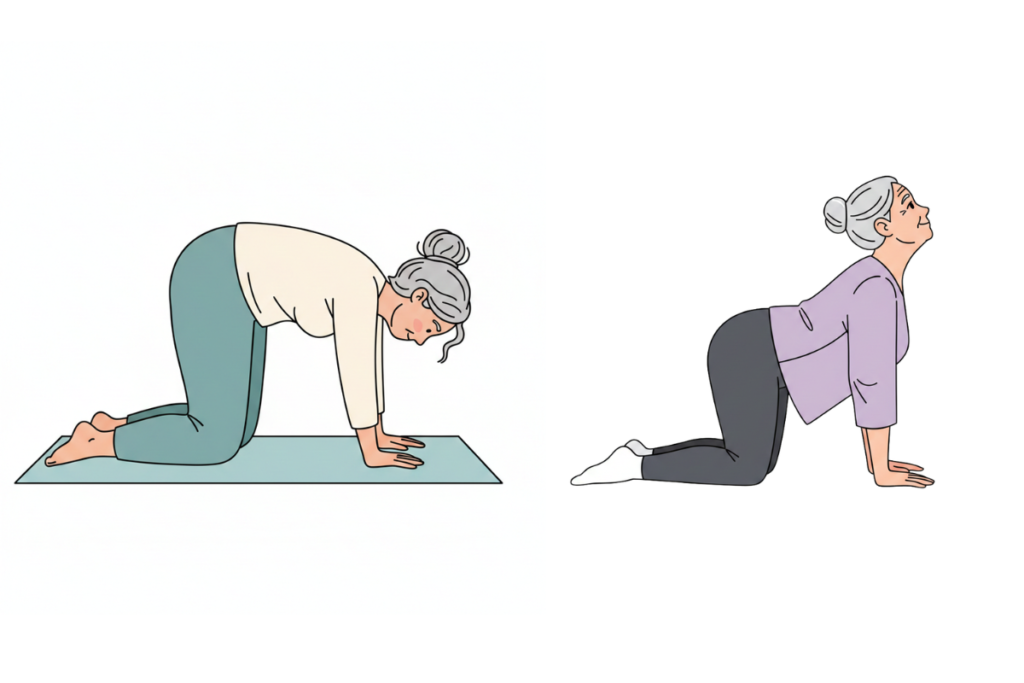
Borrowed from yoga and beloved by almost everyone who tries it, Cat-Cow gently mobilizes the entire spine from the neck to the lower back.
How to do it:
- Start on all fours on a mat with your wrists under your shoulders and knees under your hips.
- Inhale and let your belly drop toward the floor, lifting your head and tailbone upward. This is Cow.
- Exhale and slowly round your spine upward toward the ceiling, tucking your chin and tailbone. This is Cat.
- Flow gently between the two positions for 8 to 10 slow breaths.
- Let the movement be smooth and rhythmic, not rushed.
If getting on the floor is hard, try a seated version at the edge of a chair. Arch gently as you inhale and round as you exhale.
5. Child’s Pose
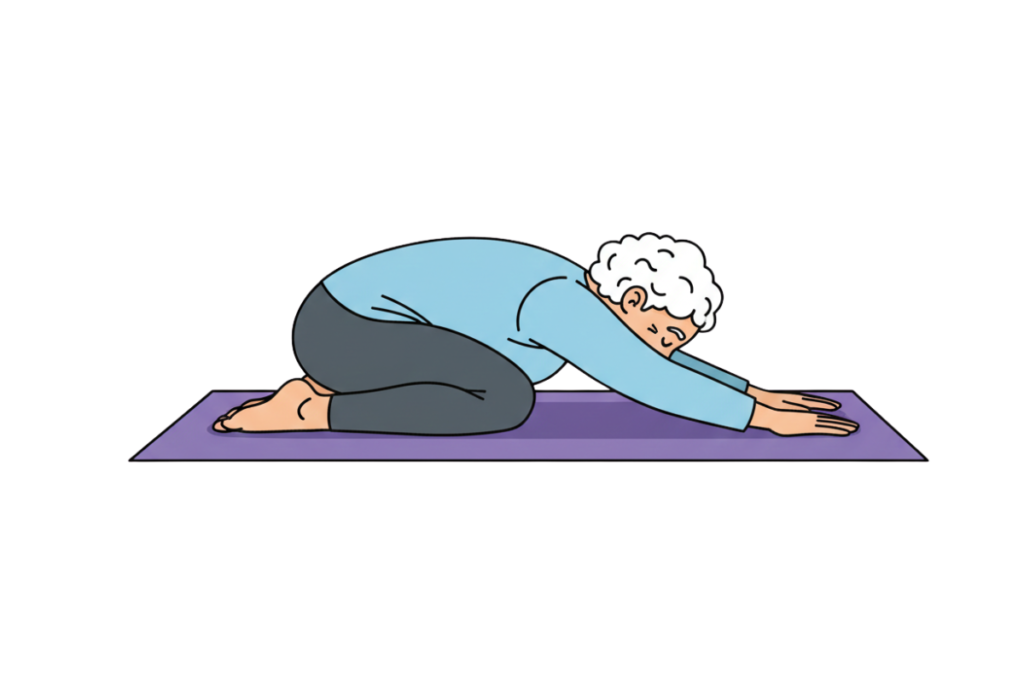
A gentle resting stretch that releases the entire back while also giving you a moment to breathe and reset. Basically, the upper back’s version of a spa day.
How to do it:
- Start on all fours on a mat.
- Slowly push your hips back toward your heels while extending your arms forward on the floor.
- Let your forehead rest on the mat or a folded blanket.
- Hold for 30 to 60 seconds while taking slow, deep breaths.
- Slowly walk your hands back in and return to all fours.
Repeat as often as you like. There is really no such thing as too much Child’s Pose when your back is tense.
6. Doorway Chest Opener
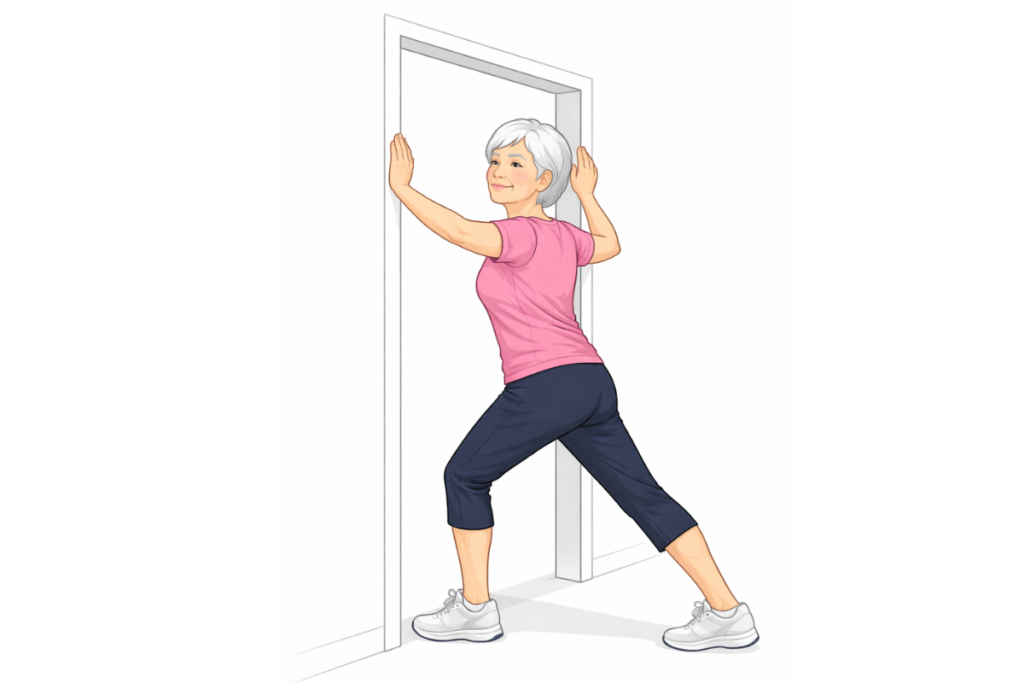
Tight chest muscles pull the shoulders forward and contribute heavily to upper back tension. Opening the chest immediately takes pressure off the upper back.
How to do it:
- Stand in a doorway and place both forearms on the door frame at shoulder height.
- Step one foot forward and gently lean into the doorway until you feel a stretch across your chest and the front of your shoulders.
- Hold for 20 to 30 seconds.
- Step back and relax.
- Repeat 3 times.
Think of this as giving your chest a chance to open up after being hunched all day. Your upper back will feel the difference right away.
7. Seated Twist
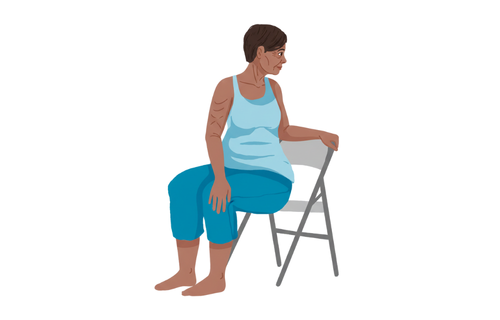
Gentle spinal rotation helps release stiffness in the thoracic spine and improves overall mobility in the upper back.
How to do it:
- Sit up straight in a chair with your feet flat on the floor.
- Place your right hand on your left knee and your left hand on the back of the chair.
- Slowly rotate your torso to the left as far as comfortable.
- Hold for 20 to 30 seconds, breathing into the stretch.
- Return to the center and repeat on the other side.
- Do 2 to 3 repetitions per side.
Focus the movement in your mid-back, not your neck. Your neck doesn’t need to join this stretch.
How to Build This Into Your Daily Routine
You don’t need to complete all eight stretches every day to see progress. Begin with two or three that feel the most comfortable, and gradually build from there as your body adapts. Using a chair yoga book for seniors can make the process feel more approachable, providing structure as you explore the best stretches for upper back pain at your own pace.
A simple approach that works well:
- Morning: Do 3 to 4 stretches to loosen up overnight stiffness before it ruins your day.
- Midday: A quick shoulder roll and seated twist can reset your posture after hours of sitting.
- Evening: A few minutes of Cat-Cow and Child’s Pose helps your body unwind before sleep.
Just ten minutes a day is enough to start noticing a difference in a week or two. The key is to keep at it, even on days when motivation is low.
Final Thoughts
Upper back stiffness can make everyday tasks harder than they need to be. Turning your head, reaching for something on a shelf, or sitting comfortably through a meal can all feel like small challenges when your back is tight. But it doesn’t have to stay that way. A few minutes of gentle stretching, done regularly and patiently, can really change how your back feels from week to week.
Choose one stretch from this list today. Just one. Do it slowly, breathe deeply, and give yourself credit for starting. Your upper back has been working hard—now it’s time to give it some care. Small, consistent steps always lead to good results. Today is a great day to take your first one.